






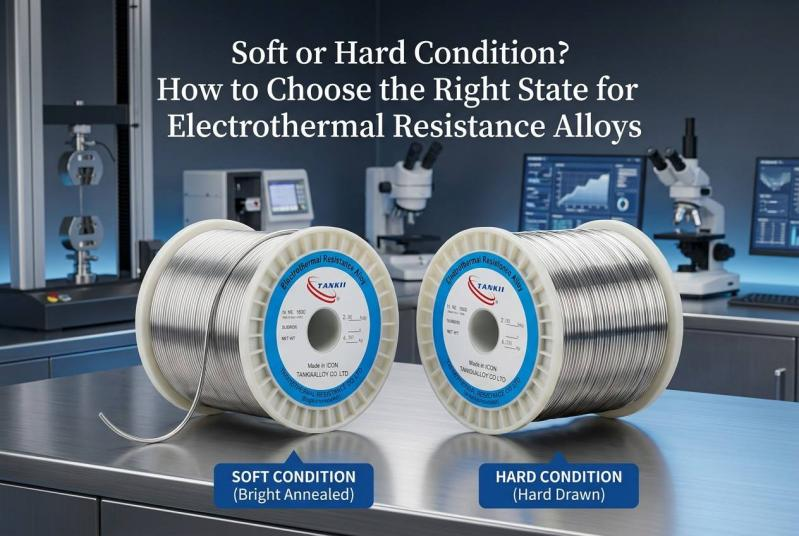
Soft or Hard Condition? How to Choose the Right State for Electrothermal Resistance Alloys
Electrothermal resistance alloys are the core basic materials for industrial heating and precision resistor industries. When selecting and purchasing alloy wires, apart from alloy grade and wire diameter specifications, supply condition (soft vs. hard) is a key parameter that is easily overlooked but directly affects processing performance and service life.
Choosing the wrong condition will not only cause fracture and excessive springback during winding and forming, but also lead to deformation and resistance drift during high-temperature service, ultimately shortening equipment service life. This article explains the selection methods of soft and hard electrothermal resistance alloys in detail from three dimensions: process essence, performance differences and application scenarios.
1. What Are Soft and Hard Conditions for Electrothermal Resistance Alloys?
1.1 Soft Condition (Annealed Condition)
The soft condition is a supply state obtained by high-temperature annealing treatment after multiple passes of cold drawing. Heat treatment eliminates the internal stress generated by cold working, restores uniform metal grain structure, and greatly improves the overall toughness of the material. It features a soft texture in appearance, can be bent easily by hand with no obvious springback, and is the mainstream state for heating element processing.
1.2 Hard Condition (Hard Drawn Condition)
The hard condition is a supply state without final annealing after multiple cold drawing processes. Cold working produces a work hardening effect inside the metal, significantly improving material strength and hardness, with relatively high internal stress. It features high rigidity and good straightness in appearance, with higher dimensional accuracy of diameter, suitable for high-speed automated processing scenarios.
2. Soft vs. Hard Condition: Core Performance Comparison
| Comparison Dimension | Soft Condition (Annealed) | Hard Condition (Hard Drawn) |
| Tensile Strength | Lower, good ductility | Higher, strong rigidity |
| Elongation | High, usually ≥20% | Low, usually <10% |
| Resistivity Stability | Excellent, uniform resistance after annealing | Good, cold working causes a slight increase in resistivity |
| Forming Springback | Minimal, easy to shape after bending | Relatively large, prone to springback deformation after forming |
| High-Temperature Creep Resistance | Excellent, low internal stress, not easy to deform at high temperature | Average, internal stress release easily leads to dimensional change |
| Processing Adaptability | Suitable for manual / complex special-shaped forming | Suitable for high-speed automated standardized production |
| Fracture Risk | Extremely low, not easy to brittle fracture when bending | Relatively high, easy to crack under large-angle bending |
3. Soft Electrothermal Resistance Alloys: Application Scenarios & Core Advantages
3.1 Core Advantages
First, excellent forming performance. Soft alloy wire has strong ductility and can be easily wound into complex shapes such as spirals, corrugations and special shapes, and is not easy to break during processing.
Second, good high-temperature stability. Annealing eliminates residual internal stress, so there will be no warping or deformation due to stress release during long-term high-temperature operation, and the heating uniformity is more stable.
Third, high resistance consistency. Heat treatment homogenizes the microstructure, so the resistivity deviation of the whole coil of wire is smaller, suitable for scenarios with high requirements on resistance accuracy.
3.2 Typical Application Scenarios
Manual / semi-automatic winding of special-shaped heating coils and complex-shaped heating elements for industrial furnaces
Precision wire-wound resistors, strain gauges, sensors and other components with high requirements for resistance accuracy
Alloys with strong brittleness tendency such as FeCrAl, soft condition is preferred to reduce processing fracture risk
Flexible heating films, bendable heating modules and other products requiring repeated deformation
4. Hard Electrothermal Resistance Alloys: Application Scenarios & Core Advantages
4.1 Core Advantages
First, higher dimensional accuracy. Hard drawn alloy wire has stricter diameter tolerance control and better surface finish, and is not easy to jam during automatic feeding.
Second, strong rigidity and support. The material has high stiffness, and the spiral shape is stable after winding, without coil collapse or deformation due to self-weight or vibration.
Third, higher production efficiency. The final annealing process is omitted, the delivery cycle is shorter, and the cost of large-batch standardized products is more competitive.
4.2 Typical Application Scenarios
High-speed automated winding of standardized products such as household appliance heating tubes and ordinary resistors
Large-diameter industrial furnace strips and flat ribbons requiring high rigid support
Components with strict dimensional tolerance requirements and adapted to automated assembly lines
Nichromeand other alloys with excellent toughness can be selected in hard condition to improve processing efficiency
5. Selection Decision: 4 Key Judgment Dimensions
5.1 First, Confirm the Processing and Forming Method
For manual winding, special-shaped forming and small-batch customization, soft condition is preferred to reduce processing scrap rate. For mass production of standard parts with high-speed automated equipment, hard condition is preferred to improve production efficiency.
5.2 Second, Confirm the High-Temperature Service Condition
For long-term high-temperature operation and scenarios with large temperature fluctuations, soft condition is preferred to avoid deformation caused by internal stress release. For room temperature or medium-low temperature operation with fixed shape, both soft and hard conditions are available, and can be selected in combination with cost.
5.3 Combine with Alloy Material Characteristics
FeCrAl alloy itself has a tendency to embrittlement, so soft condition is recommended to reduce the risk of bending fracture. Nichrome alloy has excellent toughness, and soft or hard condition can be flexibly selected according to the processing method.
5.4 Match the Accuracy Grade Requirements
For precision resistors and measuring instruments, soft condition is preferred to ensure uniform and stable resistivity. For ordinary industrial heating and civilian household appliance scenarios, it can be flexibly selected according to the processing technology.
6. Tankii Electrothermal Resistance Alloys: Customized Soft & Hard Conditions with Full Specifications
6.1 Full Alloy Category Coverage
We provide a full range of electrothermal resistance alloy wires including FeCrAl, nichrome, constantan, Karma and pure nickel. Soft, hard and semi-hard conditions can all be customized as required, with wire diameter ranging from 0.018mm to 5.0mm, adapting to the needs of all industries.
6.2 Precise Condition Control
Strictly control cold drawing deformation and annealing process parameters to ensure uniform condition of each batch of materials. Mechanical indexes such as tensile strength and elongation can be customized according to customer requirements to accurately match the processing technology.
6.3 Full-Process Quality Assurance
Each batch of products undergoes triple testing of resistivity, dimensional tolerance and mechanical properties. All products comply with domestic and international standards such as GB/T 1234, ASTM and EN, with stable and traceable performance.
Conclusion
There is no absolute advantage or disadvantage between soft and hard conditions; the core is to match the processing method and service conditions. The soft condition focuses on formability and high-temperature stability, while the hard condition focuses on rigidity accuracy and batch processing efficiency. If you are not sure which condition to choose for your project, you can contact us to provide working conditions and process information for professional selection suggestions and sample testing.
Post time: Jul-08-2026

