
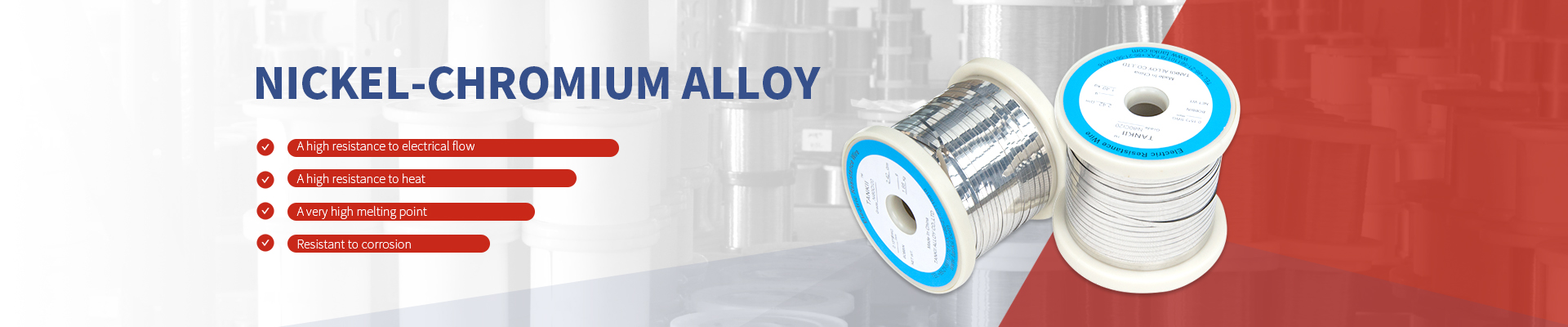

Nickel-chromium (Nichrome) alloy wires are widely used in heating, electronic, and industrial fields due to their excellent high-temperature resistance and stable electrical performance. Among them, Nicr7030 and Nicr8020 are the two most mainstream models, but there are significant differences in composition, performance, and application scenarios. Below is a detailed comparison to help you make informed purchasing decisions:
| Comparison Dimension | Nicr7030 | Nicr8020 | Other Common Models (e.g., Nicr6040) |
| Chemical Composition | 70% Nickel + 30% Chromium | 80% Nickel + 20% Chromium | 60% Nickel + 40% Chromium |
| Maximum Continuous Operating Temperature | 1250°C (Short-term peak: 1400°C) | 1300°C (Short-term peak: 1450°C) | 1150°C (Short-term peak: 1350°C) |
| Electrical Resistivity (20°C) | 1.18 Ω·mm²/m | 1.40 Ω·mm²/m | 1.05 Ω·mm²/m |
| Ductility (Elongation at Break) | ≥25% | ≥15% | ≥20% |
| Oxidation Resistance | Excellent (dense Cr₂O₃ film) | Good (thicker oxide film) | Good (prone to peeling at high temps) |
| Weldability | Superior (easy to weld with common methods) | Moderate (requires precise parameter control) | Moderate |
| Cost-Effectiveness | High (balanced performance and price) | Medium (higher nickel content increases cost) | Low (limited application scope) |
| Typical Application Scenarios | Household appliances, industrial heating, automotive heating, precision electronics | High-temperature industrial furnaces, specialized heating equipment | Low-temperature heating devices, general resistors |
Detailed Difference Analysis
1. Chemical Composition & Core Performance
The core difference lies in the nickel-chromium ratio: Nicr7030 contains 30% chromium (higher than Nicr8020’s 20%), which enhances its ductility and weldability. With an elongation at break of ≥25%, Nicr7030 can be drawn into ultra-fine wires (down to 0.01mm) or bent into complex shapes, making it ideal for products requiring precise processing (e.g., automotive seat heating wires, miniaturized electronic sensors).
In contrast, Nicr8020’s higher nickel content (80%) improves its high-temperature stability, allowing it to operate continuously at 1300°C—50°C higher than Nicr7030. However, this comes at the cost of reduced ductility (only ≥15%), making it less suitable for bending or forming processes. Other models like Nicr6040 have lower nickel content, resulting in lower resistivity and temperature resistance, limiting their use to low-demand scenarios.
2. Resistivity & Energy Efficiency
Resistivity directly affects heating efficiency and component design. Nicr8020 has a higher resistivity (1.40 Ω·mm²/m), meaning it generates more heat per unit length under the same current, making it suitable for compact high-power heating elements (e.g., high-temperature sintering furnaces).
Nicr7030’s moderate resistivity (1.18 Ω·mm²/m) strikes a balance between heat generation and energy consumption. For most industrial and consumer applications (e.g., ovens, heating pads), it provides sufficient heating power while reducing energy waste. Additionally, its stable resistivity (±0.5% tolerance) ensures consistent performance over long-term use, avoiding temperature fluctuations.
3. Oxidation Resistance & Service Life
Both Nicr7030 and Nicr8020 form protective Cr₂O₃ films at high temperatures, but Nicr7030’s higher chromium content creates a denser, more durable film. This makes it resistant to "green rot" (intergranular oxidation) in humid or reducing atmospheres, extending its service life to 8000+ hours (20% longer than Nicr8020 in harsh environments).
Nicr6040, with lower chromium content, has a less stable oxide film that is prone to peeling at temperatures above 1000°C, leading to shortened service life and increased maintenance costs.
4. Cost & Application Adaptability
Nicr7030 offers superior cost-effectiveness: its lower nickel content (compared to Nicr8020) reduces raw material costs by 15-20%, while its versatile performance covers 80% of nichrome wire application scenarios. It is the preferred choice for mass-produced products like household appliances and automotive heating systems, where balancing performance and cost is critical.
Nicr8020’s higher nickel content increases its cost, making it only necessary for specialized high-temperature applications (e.g., aerospace component testing). Other low-nickel models like Nicr6040 are cheaper but lack the performance to meet industrial or precision electronic requirements.
Selection Guide
- Choose Nicr7030 if you need: Versatile performance, easy processing (bending/welding), cost-effectiveness, and application in household appliances, automotive heating, industrial heating, or precision electronics.
- Choose Nicr8020 if you need: Higher operating temperature (1300°C+) and compact high-power heating elements (e.g., specialized industrial furnaces).
- Choose other models (e.g., Nicr6040) only for low-temperature, low-demand scenarios (e.g., basic resistors).
With its balanced performance, cost-effectiveness, and wide adaptability, Nicr7030 is the most cost-efficient choice for most customers. Our company provides customized specifications (diameter, length, packaging) and technical support to ensure Nicr7030 perfectly matches your application needs.
Post time: Dec-10-2025


