
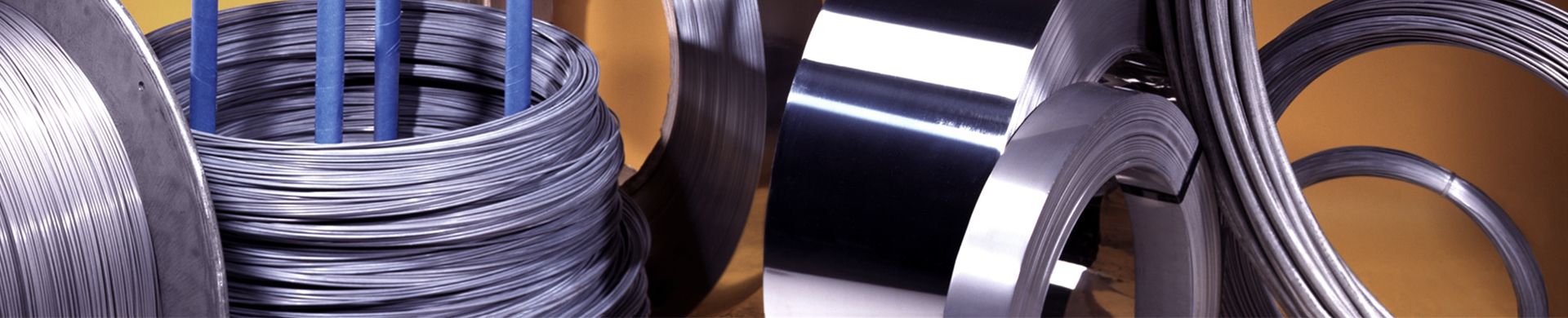



6J12, also known as modified Manganin, is a high-precision copper-manganese-nickel resistance alloy.
It is standardized under China’s national standard GB/T 15018-1994, designed for applications requiring ultra-stable resistance values and minimal temperature drift.
Key highlights:
l Ultra-low resistance temperature coefficient (TCR)
l Low thermal EMF against copper
l Excellent long-term stability
l Good ductility for fine wire drawing
l Suitable for high-precision measurement and control systems
Invention: The Birth of Manganin (1892)
The origin of 6J12 traces back to the invention of Manganin by British scientist Edward Weston in 1892.
l 1887: Weston created Constantan, the first low-TCR resistance alloy.
l 1892: Manganin was developed with a formula of Cu86%, Mn12%, Ni2%.
l Core breakthrough: Near-zero TCR near room temperature, ensuring stable resistance.
l 1901–1990: Manganin resistors served as the legal standard for the ohm in the United States.
This invention laid the foundation for all modern precision resistance materials.
Evolution: From Manganin to 6J12
6J12 is the Chinese upgraded and standardized version of traditional Manganin, optimized for modern industrial needs.
l 1950s: China began independent R&D and localization of precision alloys to break import dependence.
l 1994: China issued GB/T 15018-1994, officially naming the optimized alloy 6J12.
l Improvements: Added trace Si and Fe to enhance heat resistance and processing performance.
l Advantage: Better stability in high-temperature, high-humidity and harsh industrial environments.
6J12 Standard Composition
| Element | Content (%) | Main Function |
| Copper (Cu) | 84.0–86.0 | Base material, provides basic conductivity and mechanical toughness |
| Manganese (Mn) | 11.0–13.0 | Increases resistivity and lowers TCR to ensure resistance stability |
| Nickel (Ni) | 1.0–3.0 | Stabilizes resistance value and improves oxidation resistance |
| Si, Fe | Trace | Enhances heat resistance and wire drawability for mass production |
Key Properties of 6J12 Alloy
Electrical Properties
l Resistivity (20°C): 0.45–0.48 μΩ·m
l TCR: ≤±10×10⁻⁶/℃ (−60°C to +60°C)
l Thermal EMF vs. Cu: ≤1 μV/℃, reducing measurement errors
Physical & Mechanical Properties
l Density: ~8.4 g/cm³
l Tensile strength: 680–720 MPa
l Elongation: 12–15%
l Good plasticity, suitable for drawing fine wire down to 0.05 mm
Why 6J12 Was Developed
Traditional Manganin had limitations in processing stability and high-temperature performance, which could not meet modern industrial requirements.
6J12 was developed to solve these problems:
l Reduces resistance drift in fluctuating temperatures, ensuring measurement accuracy
l Improves service life in harsh industrial and aerospace environments
l Enhances wire drawing performance to adapt to mass production of precision wires
l Meets stricter national standards for high-precision electronic components
Typical Applications of 6J12 Wire
Our 6J12 precision alloy wire is widely used in high-accuracy fields, providing reliable performance for key components:
l Precision standard resistors and resistance boxes
l Shunts for electrical instruments, multimeters and power meters
l Strain gauges and high-precision sensors for industrial control
l Aerospace and military electronic components with high reliability requirements
l Precision measuring instruments and metrology equipment
6J12 vs. Traditional Manganin
| Item | Traditional Manganin | 6J12 Precision Alloy |
| Standard | Non-standardized | GB/T 15018-1994 |
| TCR | ±20×10⁻⁶/℃ | ≤±10×10⁻⁶/℃ |
| Heat resistance | General | Improved, suitable for high-temperature environments |
| Processability | Average | Excellent for fine wire drawing |
| Stability | Good | Excellent for long-term use |
Advantages of 6J12 in Modern Industry
l Proven heritage: Over 130 years of technical accumulation from Manganin
l Ultra-stable performance: Minimal resistance drift over time and temperature changes
l Strong processability: Ideal for mass production of precision wires of various specifications
l Compliance: Meets GB, ASTM, and IEC standards, suitable for global applications
l Cost-effective: Balances high performance and industrial affordability
Conclusion
6J12 Precision Alloy is the modern evolution of the historic Manganin, integrating 130 years of technological progress.
From its invention in 1892 to today’s national standard material, it remains irreplaceable in high-precision electronics.
Our 6J12 wire inherits this legacy, providing reliable, stable performance for precision instruments, sensors, and aerospace systems worldwide.If you have any related needs, please feel free to contact us at any time.
Post time: Apr-17-2026


