


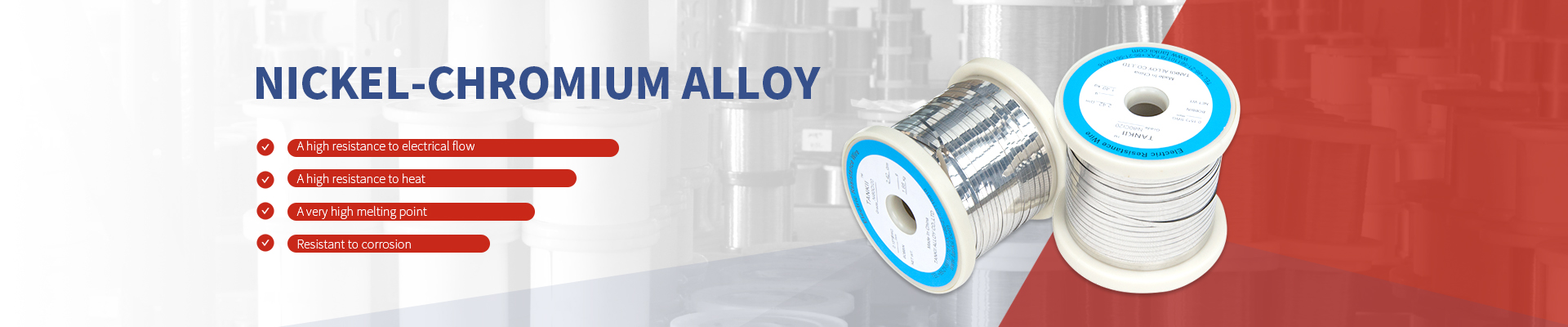

Performance Advantages and Working Condition Guide for High-Chromium Nickel-Chromium Heating Alloys
1. Introduction to Nichrome 70/30 : A High-Performance Heating Alloy With High Chromium Content
1.1 Basic Composition and Product Positioning
Nichrome 70/30 (grade Cr30Ni70, also known as Ni70Cr30) is the high-chromium variant in the nichrome heating alloy family, with a nominal composition of approximately 70% nickel and 30% chromium and strictly controlled impurities such as iron and carbon. It is classified as a high-end industrial-grade resistance heating alloy.
This alloy complies with multiple national and international standards including GB/T 1234, ASTM B344 and DIN 17470. It is an advanced material that balances high-temperature stability, oxidation resistance and resistance accuracy, making it suitable for high-temperature heating scenarios with complex working conditions.
1.2 Four Core Performance Features
Higher service temperature: It supports a long-term continuous operating temperature of up to 1250°C and a short-term peak temperature of 1300°C, higher than the conventional Nichrome 80/20 grade.
Higher electrical resistivity: Its room temperature resistivity is approximately 1.18 μΩ·m, with a low temperature coefficient of resistance. Power fluctuation is gentle during heating, enabling higher temperature control accuracy.
Strong oxidation and green corrosion resistance: The high chromium content forms a denser oxide protective film at high temperatures, delivering excellent performance in alternating oxidizing/reducing atmospheres and effectively extending element service life.
Stable high-temperature mechanical properties: It has outstanding creep resistance and deformation resistance at elevated temperatures. It does not easily sag or deform after long-term use, ensuring good structural stability of heating elements.
2. Six Core Industrial Application Scenarios of Nichrome 70/30
2.1 Heating Elements for High-End Industrial Heat Treatment Furnaces
This is the most mainstream application of Nichrome 70/30, especially for 1200°C-class high-temperature resistance furnaces, carburizing furnaces, bell furnaces and tempering furnaces.
Facing complex furnace atmospheres and large temperature fluctuations, its high oxidation and atmosphere corrosion resistance can significantly extend heating wire service life, which is around 40% longer than ordinary alloys.
2.2 Kiln Heating in Glass and Ceramic Industries
Heating zones of glass melting furnaces and ceramic sintering kilns feature high temperatures and heavy alkaline vapor atmosphere, which are highly corrosive to heating materials.
The high-chromium formula of Nichrome 70/30 better resists alkaline atmosphere erosion, maintains stable heating power, ensures temperature uniformity across kiln zones, and reduces downtime for element replacement.
2.3 Heating Units for Semiconductor and Electronics Manufacturing
Processes such as semiconductor wafer annealing, package thermocompression bonding and electronic component sintering impose extremely high requirements on temperature uniformity and cleanliness.
This alloy features stable resistance and uniform heat generation, with low volatile matter at high temperatures that will not contaminate the process environment. It is often made into precision heating rods and heating plates for high-end electronics manufacturing equipment.
2.4 Precision Resistors and Sensor Elements
With its low temperature coefficient of resistance and excellent long-term resistance consistency, Nichrome 70/30 is used to manufacture high-precision wire-wound resistors and resistor cores for automotive oxygen sensors.
Its performance meets the strict requirement of military-grade resistance TCR ≤ 50 ppm/°C, maintaining stable resistance across a wide temperature range.
2.5 High-End Household and Commercial Heating Equipment
Nichrome 70/30 is also the material of choice for high-end ovens, industrial heat guns, plastic thermoforming molds and other commercial/household products that demand long heating life and high stability.
Compared with ordinary nichrome wire, it withstands more frequent cold-hot cycles and has minimal power attenuation after long-term use, improving overall product reliability.
2.6 Specialized Heating in Chemical and Metallurgical Industries
In scenarios such as corrosive atmosphere heating in the chemical industry and sample melting furnaces in the metallurgical industry, ordinary materials are prone to corrosion failure.
Nichrome 70/30 has good tolerance to various acid and alkali atmospheres, and can operate stably in high-temperature environments with mild corrosion, expanding the application boundary of electric heating alloys.
3. Core Differences Between Nichrome 70/30 and Other Nichrome Series Alloys
3.1 Comparison of Mainstream Nichrome Alloy Parameters
To visually demonstrate the differences, the table below compares the core indicators of three most commonly used industrial nichrome alloys:
| Performance Parameter | Nichrome 70/30 (Cr30Ni70) | Nichrome 80/20 (Cr20Ni80) | Nichrome 60/15 (Cr15Ni60) |
| Nominal Composition | Ni 70% + Cr 30% | Ni 80% + Cr 20% | Ni 60% + Cr 15%, Fe balance |
| Max Continuous Service Temp | 1250°C | 1200°C | 1150°C |
| Room Temp Resistivity (μΩ·m) | 1.18±0.05 | 1.09±0.05 | 1.11±0.05 |
| Oxidation Resistance | Excellent, withstands alternating atmospheres | Good, stable in air environment | Moderate, suitable for stable atmospheres |
| High-Temp Creep Resistance | Excellent | Good | Fair |
| Material Cost | Relatively high | Medium | Relatively low |
| Primary Positioning | High-end industrial grade, complex working conditions | General purpose, conventional heating | Economical grade, medium-low temperature heating |
3.2 In-Depth Analysis of Key Differences
Differences from Nichrome 80/20: Nichrome 80/20 is the most classic general-purpose nichrome alloy. It has higher nickel content, better forming ductility and moderate cost, suitable for most conventional heating scenarios in air environment.
Nichrome 70/30 has a 10 percentage point higher chromium content. It sacrifices part of its ductility in exchange for higher service temperature, stronger oxidation and atmosphere corrosion resistance. It is more suitable for industrial scenarios with complex furnace atmospheres, higher temperatures and strict service life requirements.
Differences from Nichrome 60/15: Nichrome 60/15 contains a certain amount of iron, with lower cost and moderate resistivity. It is mainly used for medium-low temperature heating below 1000°C, ordinary household appliance heating wires and potentiometer resistors.
Nichrome 70/30 contains almost no iron, and is fully superior in high-temperature stability and corrosion resistance. It is positioned for high-end industrial applications, with a clear gap in applicable working conditions.
4. Selection Recommendations for Different Working Conditions
Conventional air environment, below 1100°C, cost-effective priority: Choose Nichrome 80/20 first. It has balanced comprehensive performance and better procurement cost.
1100–1200°C high temperature, fluctuating furnace atmosphere, high life requirement: Choose Nichrome 70/30 first. It delivers lower comprehensive cost in long-term use.
Below 1000°C, mass-produced household appliances, budget-sensitive: Nichrome 60/15 is optional. It meets basic heating demand with outstanding economy.
Strong corrosive atmospheres such as sulfur or alkaline vapor: Ordinary nichrome alloys are not recommended. Prioritize evaluation of Nichrome 70/30 or higher-end special alloys.
5. Advantages of Tankii Nichrome 70/30 Products
5.1 Dual Control of Composition and Process for Stable Performance
Tankii’s Nichrome 70/30 alloy strictly implements both national standard and ASTM standards, with composition deviation controlled within a narrow range to ensure resistivity consistency across every batch.
Adopting multi-pass precision drawing process, it features precise wire diameter tolerance and a smooth, defect-free surface, ready for automated winding and welding directly.
5.2 Full Specification Range With Customization Support
Products cover multiple forms including wire, strip, rod and flat wire, with wire diameter ranging from 0.05mm to 6.0mm. Specifications and coil weights can be customized according to customer equipment requirements.
We also provide deep processing services such as pre-oxidation treatment and straightening, reducing on-site processing procedures for customers.
5.3 Full-Process Technical Support
We provide targeted material selection and element design recommendations based on customers’ furnace structure, operating temperature and atmosphere environment, helping customers optimize heating element life and heating efficiency.
From selection testing to batch application, our technical team follows up throughout the process to solve various problems during use.
Conclusion
As a representative of high-chromium nichrome alloys, Nichrome 70/30 is a high-quality choice that balances high-temperature performance, corrosion resistance and cost, especially suitable for industrial scenarios with high requirements for heating stability and service life.
Choosing the right alloy grade not only ensures stable equipment operation, but also reduces maintenance and replacement costs in the long run.
If you have selection questions or procurement needs for nichrome alloys, welcome to contact the Tankii technical teamAbout Us – TANKII ALLOY(XUZHOU) CO., LTD for professional material solutions.
Post time: Jul-28-2026

