




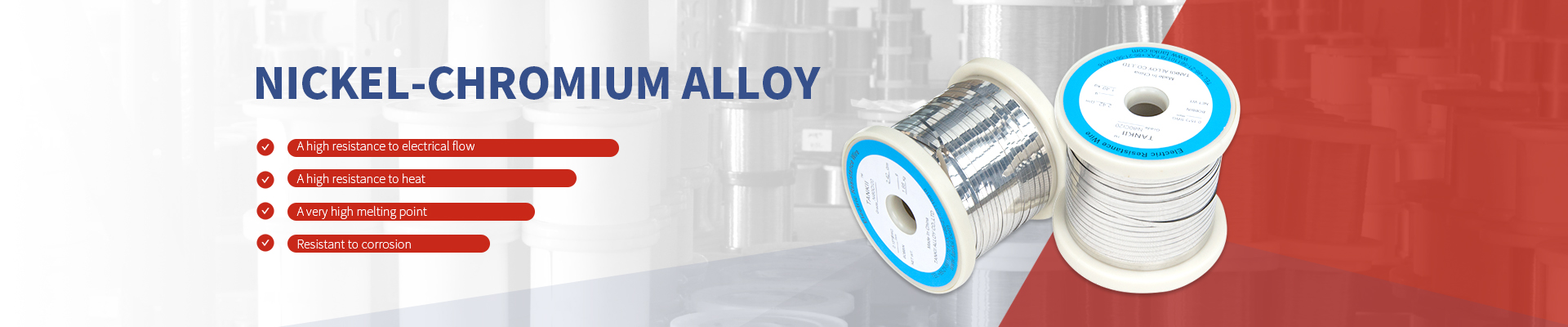

Constantan resistance heating wire is a core alloy material for precision resistance and medium-low temperature heating applications. Featuring an ultra-low temperature coefficient of resistance, excellent long-term resistance stability, high fatigue resistance and outstanding formability, it is widely used in precision instruments, electronic appliances, industrial heating, sensing and measurement scenarios. Many enterprises focus only on material selection and processing in inventory management, yet overlook standardized storage practices. Improper storage issues such as moisture-induced oxidation, compression deformation and corrosive contamination will directly lead to resistance drift, processing fracture, welding failure, and even scrap of entire batches.
This article explains the correct storage methods, core control points and common misconceptions for constantan resistance heating wire based on its material properties, helping enterprises reduce inventory loss and maintain stable material performance.
Material Properties of Constantan and the Importance of Standardized Storage
1.1 Core Material Characteristics
Constantan is a precision resistance alloy mainly composed of copper and nickel, typically with around 55% copper and 45% nickel. It has an extremely low temperature coefficient of resistance and excellent long-term resistance stability.
It maintains stable resistance performance across a wide temperature range, while boasting outstanding corrosion resistance, fatigue resistance and formability. This makes it the mainstream choice for precision wire-wound resistors, temperature compensation components and low-temperature heating devices.
However, when long exposed to high-humidity or corrosive environments, the surface of constantan alloy will gradually oxidize and form an oxide film, which directly impairs weldability and resistance accuracy. External compression can easily cause wire diameter deformation, making resistance deviation exceed the tolerance range.
1.2 Value of Standardized Storage
Standardized warehousing and storage is an extension of product quality control, and a key link to ensure the performance of constantan wire.
For precision-grade constantan wire, even slight oxidation or minor wire diameter deformation may cause out-of-tolerance resistance, resulting in substandard accuracy of end components.
Reasonable storage methods not only extend the material shelf life and reduce scrap loss, but also cut pre-processing procedures and improve production efficiency, reducing overall usage cost from the source.
2. 5 Core Storage Requirements for Constantan Resistance Heating Wire
2.1 Control Temperature and Humidity to Prevent Moisture Oxidation
Ambient temperature and humidity are the primary factors affecting the performance of constantan wire.
It is recommended to keep the storage environment at 10°C–30°C with a relative humidity of 30%–60%, and avoid condensation, water accumulation and high-humidity conditions throughout the storage period.
The warehouse should be kept dry and ventilated, away from water sources, steam pipes and outdoor areas. For regions with plum rain seasons or high humidity, it is advisable to place desiccants on shelves or equip industrial dehumidifiers to prevent blackening of the wire surface due to oxidation.
2.2 Keep Sealed Packaging to Isolate Corrosion and Contamination
Constantan wire is delivered with moisture-proof sealed packaging. It is recommended to keep the original packaging during warehousing and daily storage, and do not remove the sealing layer casually.
If partially used after unpacking and needs to be stored separately, repack it with moisture-proof bags or anti-rust paper to avoid long-term exposure of the wire to air.
The storage area must be kept away from acid-base reagents, corrosive gases, oil stains and chemical raw materials to prevent surface corrosion and contamination. Meanwhile, dust should be cleaned regularly to avoid impurity adhesion that affects subsequent welding and insulation treatment.
2.3 Standardize Placement to Prevent Compression and Deformation
Constantan wire is mostly supplied in spool packages. It should be placed upright on shelves, and multi-layer stacking and squeezing are prohibited to prevent spool deformation that causes wire bending, knotting or loosening.
Constantan wires of different diameters, accuracy grades and batches should be stored in separate zones with clear labels to avoid material mixing and misuse.
Fine-gauge constantan wire (below 0.1mm) is relatively soft and more sensitive to deformation. It requires separate key protection, and heavy objects shall not be placed on it to prevent resistance deviation caused by wire diameter deformation.
2.4 Establish Inventory Management and Follow FIFO Principle
Establish a clear inventory ledger, and mark each coil with alloy grade, wire diameter specification, accuracy grade, warehousing date and shelf life information.
Industrial-grade and precision-grade products shall be stored in separate zones, and different batches shall be strictly distinguished to avoid mixing of accuracy grades.
Strictly implement the First In, First Out (FIFO) delivery principle to reduce long-term inventory backlog and ensure materials are put into production within the optimal performance period.
2.5 Supplementary Rules for Long-Term Storage and Special Scenarios
For materials stored for more than 6 months, regular sampling inspection of appearance and resistance value should be carried out to confirm normal performance before put into use.
Processed constantan heating elements shall be placed separately during storage to avoid structural deformation caused by hooking and collision with each other.
Handle with care during transportation to avoid packaging damage. Once damp or damaged packaging is found, check the wire condition in time and re-apply moisture-proof treatment.
3. 3 Common Storage Misconceptions to Avoid
3.1 Misconception 1: Random Mixed Storage Without Moisture Protection
Many enterprises mix constantan wire with ordinary metal materials, even place it directly on the floor or against the wall, which makes it highly prone to moisture absorption and oxidation.
There may be no obvious change in appearance in the short term, but the resistance value has already drifted. The substandard accuracy will only be found after processing into finished products, causing greater production losses.
3.2 Misconception 2: Long-Term Uncovered Placement After Unpacking
Unused constantan wire after unpacking in the workshop is often left exposed at the work station, long exposed to air, oil stains and dust.
This will not only accelerate surface oxidation, but also cause surface contamination, which directly affects subsequent welding performance and insulation layer adhesion, and increases the product defect rate.
3.3 Misconception 3: Uniform Management Ignoring Gauge and Accuracy Differences
Thick and thin constantan wires have different storage tolerance, and precision-grade and industrial-grade products also have different environmental requirements.
Fine-gauge and high-precision constantan wires are more sensitive to deformation and oxidation. Extensive management in accordance with ordinary industrial materials will easily lead to batch scrap.
4. Tankii Constantan Resistance Heating Wire: Standardized Packaging & Stable Performance
4.1 Standard Moisture-Proof Packaging for Long-Term Storage
Our constantan resistance heating wire is delivered in moisture-proof sealed packaging, with built-in anti-rust paper and desiccant, which effectively isolates moisture and contaminants.
The spools are made of high-strength reels, which are not easy to deform during transportation and stacking, maximizing the performance state of the wire upon delivery.
We can customize products with different coil weights and packaging specifications according to customers’ inventory and usage scenarios.
4.2 Full Specifications with Traceable Quality
We provide a full range of constantan wires in industrial and precision grades, with wire diameters covering 0.02mm to 3.0mm. Resistance tolerance and temperature coefficient strictly comply with relevant standards.
The alloy has uniform composition and high surface finish. With proper storage, it delivers excellent long-term resistance stability.
Each batch of products is accompanied by a material test report and resistance test report, with traceable performance parameters.
4.3 Full-Process Technical Support
We can provide customers with complete warehousing and storage specifications as well as processing and usage guidelines, and offer targeted storage suggestions for different regional climates and working conditions.
Our technical team can assist in solving problems such as oxidation and resistance changes encountered in storage and processing, and provide full-process material solutions from selection to implementation.
Conclusion
The performance guarantee of constantan resistance heating wire lies not only in the manufacturing process, but also in warehousing and storage, which is a key link that cannot be ignored.
Good environmental control, packaging protection, standardized placement and ledger management can keep materials in optimal performance, reduce inventory loss, and ensure the quality and stability of end products from the source.
If you have procurement needs for constantan wire, or want to know more professional suggestions on storage and processing, welcome to contact the Tankii technical team. We will provide you with professional alloy material solutions.
Post time: Jul-17-2026

